Unifying Data Integration & Consolidation for Business Insights
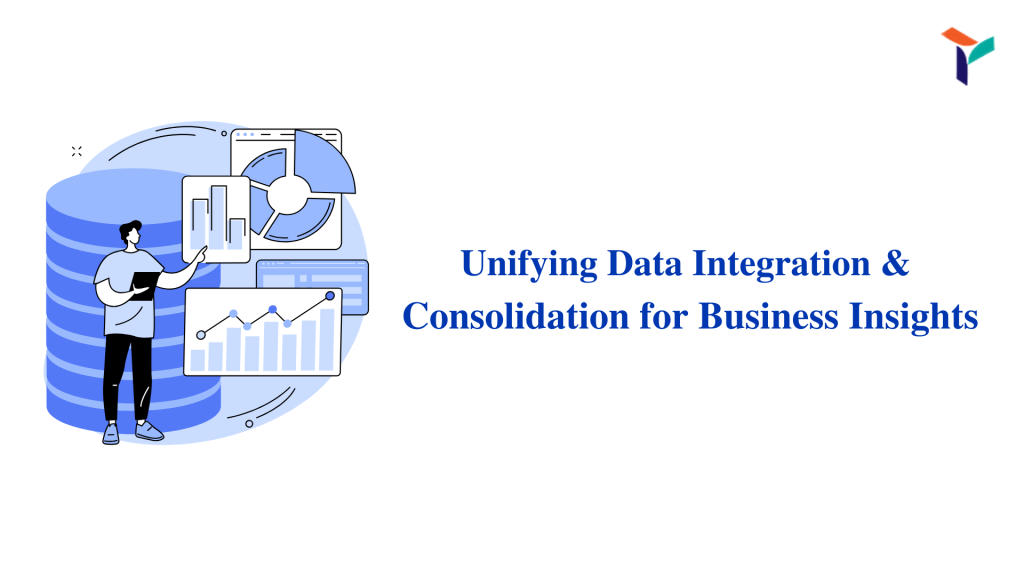
You must have heard that data is the backbone of decision-making. Yet, over 40% of businesses fail due to difficulties with data consolidation across sources in an integrated manner.
That results in inaccurate, incomplete, or redundant data, leading to poor insights and costly mistakes.
The Solution? A structured Data Integration & Consolidation approach that transforms raw data into valuable insights.
Read this guide to understand how you can unify your data for better business decisions.
What Is Data Integration & Consolidation?
Data integration is the process of combining information from different sources into a single, usable format.
Whereas, Consolidation goes a step further, ensuring data accuracy, removing duplicates, and standardizing formats for a seamless business intelligence system.
Why Is It a Must for Your Business?
Without a unified data system, businesses face:
- Data silos: Information trapped in separate databases, limiting visibility.
- Inconsistent reporting: Conflicting figures create confusion.
- Slow decision-making: Time wasted reconciling data manually.
- Compliance risks: Errors in records may lead to regulatory fines.
On the other hand, integrating and consolidating data provides:
✔ Real-time insights for faster, informed decisions.
✔ Accurate forecasting and analytics for growth strategies.
✔ Increased operational efficiency with automated processes.
✔ Stronger security and compliance by standardizing data management.
Easy Steps to Unify Your Data
The process doesn’t have to be complicated. Here’s how you can start:
1. Identify Data Sources
List all platforms where your data resides—CRM, ERP, cloud storage, or third-party tools.
2. Standardize Data Formats
Ensure all data follows a consistent structure to eliminate duplication and mismatches.
3. Use ETL (Extract, Transform, Load)
An ETL pipeline automates data extraction, transformation, and loading into a centralized system.
4. Implement a Data Governance Framework
Set rules and security policies to ensure data quality, integrity, and compliance.
5. Utilize AI & Automation Tools
Leverage AI-driven insights and automated processes for real-time data accuracy.
Data Integration vs. Data Consolidation
| Feature | Data Integration | Data Consolidation |
| Purpose | Connects multiple systems | Merges into a single source |
| Data Format | Different formats | Standardized format |
| Use Case | Multi-system access | Centralized reporting |
| Example | Syncing CRM & ERP | Creating a unified dashboard |
Bottom Line: Let TRIOTECH SYSTEMS Streamline Your Data
At TRIOTECH SYSTEMS, we turn fragmented data into powerful business insights. Our data integration & consolidation services ensure your information is accurate, accessible, and actionable.
Get a streamlined data system today:
Read More:
Keep reading
Managed DevOps Cloud Security Company: Best Practices & Benefits for Healthcare
In today’s rapidly evolving healthcare landscape, organizations face intense pressure to deliver secure, compliant, and innovative digital solutions while safeguarding sensitive patient data. A specialized managed…
Read article
The Top-Performing DevOps Tools in 2025
If you're looking to modernize your development workflow, the tools you use are no longer optional. The best DevOps teams in 2025 are defined not just…
Read article
How to Reduce Downtime During Software Updates
If your team loses sleep every time a software update goes live, the real issue isn’t the update — it’s the way it’s being deployed. To…
Read articleBuilding on AI or the cloud?
Get a security architect's review of your cloud, CI/CD and AI agent permissions. Free.