HIPAA compliant. cloud infrastructure
Built to hold up under a real audit — not a checklist.
Triotech Systems designs and manages HIPAA compliant cloud infrastructure for healthcare, telehealth, and health-tech teams running production workloads on AWS, Azure, or GCP. We build the technical safeguards the HIPAA Security Rule actually requires into your infrastructure from the first deployment — not retrofitted after a failed audit.
What is HIPAA compliant cloud infrastructure?
The extractable answer
A cloud environment configured to meet the administrative, physical, and technical safeguards required under the HIPAA Security Rule for any system handling electronic protected health information (ePHI). No cloud platform is "HIPAA certified" out of the box. AWS, Azure, and GCP are HIPAA-eligible — they'll sign a BAA and provide the underlying services — but whether your environment is actually compliant depends on how encryption, network segmentation, IAM, logging, and backup retention are configured on top of that platform.
Clear lines of ownership.
What the platform gives you, what we take on, and what you get at the end.
HIPAA-eligible cloud
AWS / Azure / GCP sign a BAA and offer services capable of holding ePHI. Foundation only.
The configuration layer
Encryption, isolation, IAM, logging, backups, monitoring, & evidence configured to the standard.
A compliant environment
Architecture that survives a live compliance review or client security questionnaire.
Every HIPAA engagement covers the full control set.
What's included

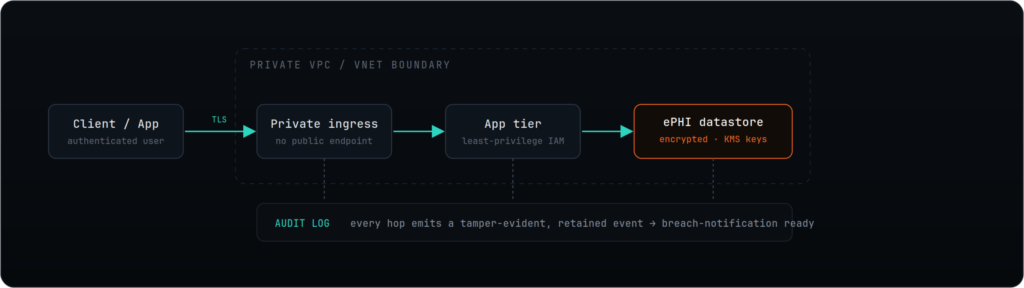
- Encryption at rest and in transitWith KMS/Vault-managed keys.
- VPC/VNet network isolation and private endpointsFor PHI workloads.
- Centralized audit loggingWith tamper-evident retention.
- BAA execution and subprocessor tracking
- Automated backupDR, and breach-notification-ready incident response.
- AI-assisted SAST/DAST/SCA scanning and quarterly penetration testing
- Continuous evidence collection mapped to the HIPAA Security Rule
- Encryption at rest and in transitWith KMS/Vault-managed keys.
Four stages, one continuous evidence trail.
GAP ASSESSMENT → AUDIT-READY ENVIRONMENT
HIPAA gap assessment
We map your environment against the Security Rule and flag exactly where you're exposed.
Secure architecture
Network isolation, KMS/Vault keys, least-privilege IAM, centralized tamper-evident logs.
Implementation & BAA
Deployed with policy-as-code; BAAs confirmed for every subprocessor touching PHI.
Continuous monitoring
Automated evidence, quarterly pen testing, 24/7 monitoring, always audit-ready.

A track record auditors sign off on
Numbers matter more than promises here.
Compliance built into the pipeline, not bolted on.
Why healthcare teams choose us
Built into the pipeline
Policy-as-code and automated evidence collection wired to your cloud accounts, CI/CD, and identity provider tools.
Not platform-locked
Not locked to one platform — AWS, Azure, or GCP, with VPC/VNet isolation, KMS-backed encryption, and BAA services.
Audit-ready on schedule
A median of seven months to SOC 2 Type II readiness starting from zero — the same discipline applies to HIPAA too.
Actually secure
AI-assisted SAST, DAST, and SCA scanning, plus quarterly penetration testing and continuous daily threat scanning.
Not just healthcare
The same rigour we apply to healthcare clients also covers fintech and crypto under SOC 2, ISO 27001, and PCI-DSS.
An extension of your team
We work as an extension inside your own engineering org, not as an outside auditor who shows up just once a year.
Why choose Triotech?
One team, six disciplines
AIOps, Cloud & FinOps, DevSecOps, Data & MLOps, AI Agents & QA, and product engineering.
Certified security leadership
CISSP, CSSLP, and DevSecOps-certified leadership sets the technical bar for every engagement, not just the sales conversation.
Multi-vertical experience
Engagements across finance, healthcare, and other regulated industries, where compliance and uptime requirements are non-negotiable.
Toronto-based since 2020
An engineering studio with a Toronto base, direct technical leadership, and a global engineering bench supporting clients across time zones.
Agile, CI/CD-driven delivery
Solutions shipped through automated development workflows and continuous integration/deployment, so releases stay fast without skipping review.
This work, in production.
Real engagements with numbers attached.
All case studiesHow a healthcare ride platform shut out a former admin and moved to a fully audited cloud
Read case studyHow The Schools Platform went from an idea to a secure, multi-tenant SaaS in 12 months
Read case studyScoped per engagement. No hourly guesswork.
How it works
The right architecture for a five-person telehealth startup looks nothing like the right architecture for a multi-region EHR platform. After a short discovery call, we provide a fixed-scope proposal covering assessment, implementation, and ongoing compliance operations — so you know the full cost before any work starts.
Questions about HIPAA Compliant Cloud.
No. They're HIPAA-eligible platforms they'll sign a BAA and offer services that can support ePHI but compliance depends on how you configure encryption, access controls, network isolation, and logging on top of the platform, not on the provider alone.
Yes any cloud provider or subprocessor that touches ePHI needs a signed BAA, since HIPAA holds you accountable for how third parties handle patient data on your behalf. We track and confirm BAAs for every subprocessor in your stack as part of the build, not just at signup.
Hosting just means the provider is HIPAA-eligible and willing to sign a BAA — it doesn't mean anything running on it is compliant. Architecture is the configuration layer: encryption, network isolation, IAM, and logging built to the Security Rule's actual requirements on top of that hosting.
Yes. As a subprocessor with access to your environment, we sign a BAA directly with you, and we track and confirm BAAs for every other subprocessor touching PHI in your stack as part of the engagement.
Book a working sessions
A security architect reviews your cloud, CI/CD and AI setup. Written report in five business days. Free.