DevSecOps
Compliance Services

Built so the evidence already exists before an auditor ever asks for it.
Triotech Systems builds security directly into your delivery pipeline as a programmatic practice, from policy-as-code guardrails to dedicated AI red-teaming against live models, turning continuous compliance into a natural byproduct of how your team already ships code, not a dreaded process bolted on before an audit.


DevSecOps
Compliance Services

Built so the evidence already exists before an auditor ever asks for it.
Triotech Systems builds security directly into your delivery pipeline as a programmatic practice, from policy-as-code guardrails to dedicated AI red-teaming against live models, turning continuous compliance into a natural byproduct of how your team already ships code, not a dreaded process bolted on before an audit.

SOC 2

SOC 2

ISO 27001

PCI-DSS

SAST

SAST

DAST

IAST

SCA

Maps to

SOC 2

ISO 27001

PCI-DSS

Built into

DAST

SAST

IAST

SCA

Maps to

SOC 2

ISO 27001

PCI-DSS

Built into

SAST

DAST

IAST

SCA

SAST

SAST

DAST

IAST

SCA

What are DevSecOps compliance services?

The plain version

Taking the old model, where a security team reviews code near the end and a compliance team audits everything once a year, and replacing it with something that runs continuously and automatically inside the same pipeline your engineers already use to ship. The evidence gets generated as a byproduct of engineering work that was already happening, not assembled manually before an audit.
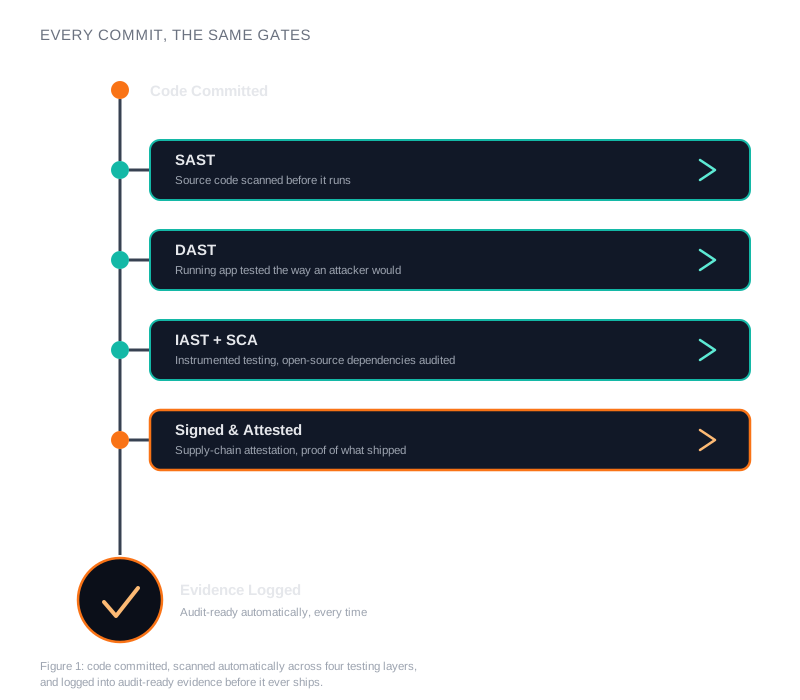
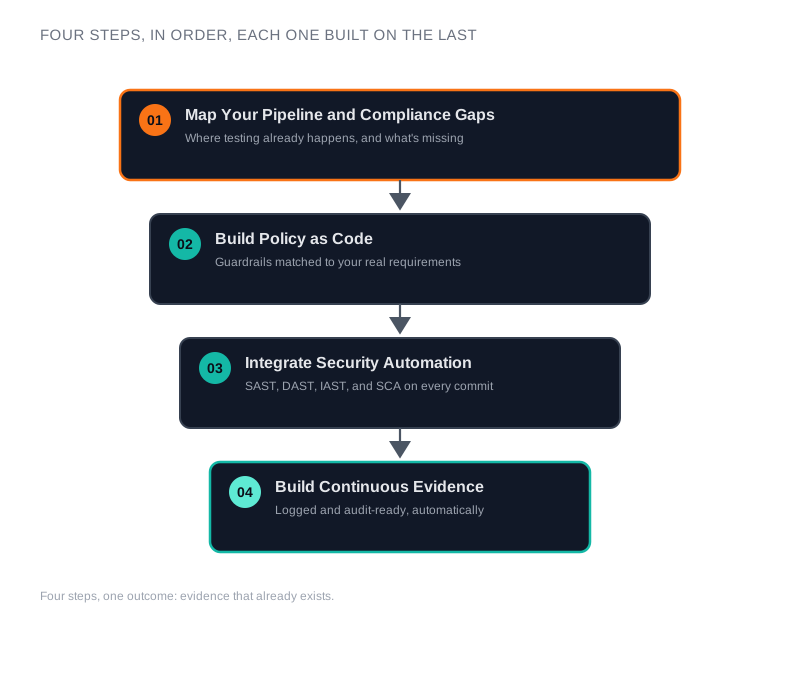
Figure 1: code committed, scanned automatically across four testing layers, and logged into audit ready evidence before it ever ships
The platform provides

Security Pipeline Automation

SAST, DAST, IAST, and SCA running on every commit instead of once before a release, so gaps get caught while code is still moving.
Triotech owns

Policy as Code & AI Red-Teaming

Policy-as-code guardrails, signed artifacts, and AI red-teaming against your own models, built around your actual requirements, not a template.
The result

Evidence That Already Exists

Evidence an auditor asks for already exists, generated automatically every time code moves through the pipeline, not assembled under deadline.

One team, six disciplines

AIOps, Cloud & FinOps, DevSecOps, Data & MLOps, AI Agents & QA, and product engineering.

Certified security leadership

CISSP, CSSLP, and DevSecOps-certified leadership sets the technical bar for every engagement, not just the sales conversation.

Multi-vertical experience

Engagements across finance, healthcare, and other regulated industries, where compliance and uptime requirements are non-negotiable.

Toronto-based since 2020

An engineering studio with a fixed home base and a public track record—not an anonymous offshore contracting pool.

Agile, CI/CD-driven delivery

Solutions shipped through automated development workflows and continuous integration/deployment, so releases stay fast without skipping review.

Four steps, one outcome: evidence that already exists.

01

Map Your Pipeline and Compliance Gaps Honestly

Where security testing already happens, where it doesn’t, and what evidence an auditor would ask for that you couldn’t currently produce.
02

Build Policy as Code Around Real Requirements

Not a generic template, guardrails that reflect the specific controls your compliance framework actually requires, enforced automatically.
03

Integrate Security Pipeline Automation

SAST, DAST, IAST, and SCA running on every commit, with secret scanning and signed artifacts closing the gaps left between them.
04

Build Continuous Compliance Evidence

Every control, every scan result, every deployment gets logged in a form that’s actually usable in an audit, generated automatically.
PIPELINE AUDIT → AUDIT-READY EVIDENCE, BUILT IN

ONGOING →

MEDIAN 7 MONTHS TO SOC 2 TYPE II READINESS

Here's what's actually in scope.

Built on real credentials, not just process.

Since 2020

Running Production Since 2020

Building security directly into delivery pipelines since 2020, for fintech, healthcare, crypto, and e-commerce clients who can’t afford a gap.
One Practice

One Practice, Every Regulated Industry

The same policy-as-code and evidence collection practice shows up whether we’re securing fintech payments, healthcare PHI, or crypto exchanges.
Compliance as a Floor

Compliance as a Floor, Not a Ceiling

Compliance as a Floor, Not a Ceiling Meeting the minimum SOC 2 checklist and actually being secure aren’t always the same thing, we build toward genuine security posture first.
Outcomes, Not Activity

We Measure Audit Outcomes, Not Activity

Median 7 months to SOC 2 Type II readiness from zero, 0 critical findings across our last 11 penetration tests, the numbers that matter.
Real Credentials

Real Credentials, Not Marketing Language

Our founder holds CISSP and CSSLP certifications, the second one focused specifically on secure software lifecycle, the actual discipline here.
Numbers, Not Buzzwords

We Compete on Numbers, Not Buzzwords

The automation and continuous evidence collection are the actual substance here, not a marketing layer attached to conventional consulting.

No flat number. A scoped proposal instead.

How it works

There’s no flat number that would mean anything here, a startup needing SOC 2 Type II readiness from scratch is a different engagement than an established fintech platform adding AI red-teaming to an already mature practice. We’ll start with an honest look at your pipeline and compliance posture, and come back with a scoped proposal so you know the real cost and timeline before committing.
How it works

There’s no flat number that would mean anything here, a startup needing SOC 2 Type II readiness from scratch is a different engagement than an established fintech platform adding AI red-teaming to an already mature practice. We’ll start with an honest look at your pipeline and compliance posture, and come back with a scoped proposal so you know the real cost and timeline before committing.

Numbers matter more than promises here.

7mo

Median time to SOC 2 Type II readiness from zero, the discipline behind every guardrail we build into your pipeline.

0

Critical findings across our last 11 external penetration tests, the same zero across every practice we run.

100%

Of active compliance clients audit-ready in the quarter they needed to be, every quarter, not just the good ones.

What Our Clients Are Saying

Discover the experiences and feedback from Our Valued Clients.

Learn how We can help your industry

Schedule a meeting with us to find out how TRIOTECH SYSTEMS can help your industry.

favicon

Connect with Us

Fill in your details below and we'll get back to you!

Thank You

We have received your inquiry and will get back to you soon

Frequently Asked Questions

Everything you need to know about working with TRIOTECH SYSTEMS.

What's the actual difference between DevSecOps and traditional application security?

Traditional application security usually means a review near the end of a release cycle, done by a separate team. DevSecOps builds the same testing and policy enforcement directly into the pipeline your engineers already use, running continuously instead of as a gate at the end.

SOC 2 Type II requires demonstrating controls operated effectively over time, not just that they exist on paper. Continuous compliance evidence collection is exactly the kind of ongoing proof a SOC 2 Type II audit requires, generated automatically instead of assembled manually before the audit window.

SAST scans your source code for vulnerabilities before it runs. DAST tests the running application from the outside, the way an attacker would. IAST combines both by instrumenting the app during real testing. SCA audits your open-source dependencies for known vulnerabilities.

Yes, if you’re running AI models or agents in production, traditional application security testing wasn’t built for risks like prompt injection or manipulated model outputs. AI red-teaming is a distinct discipline testing for those specific failure modes.

Update cookies preferences