Enterprise Agentic AI Reference Architecture
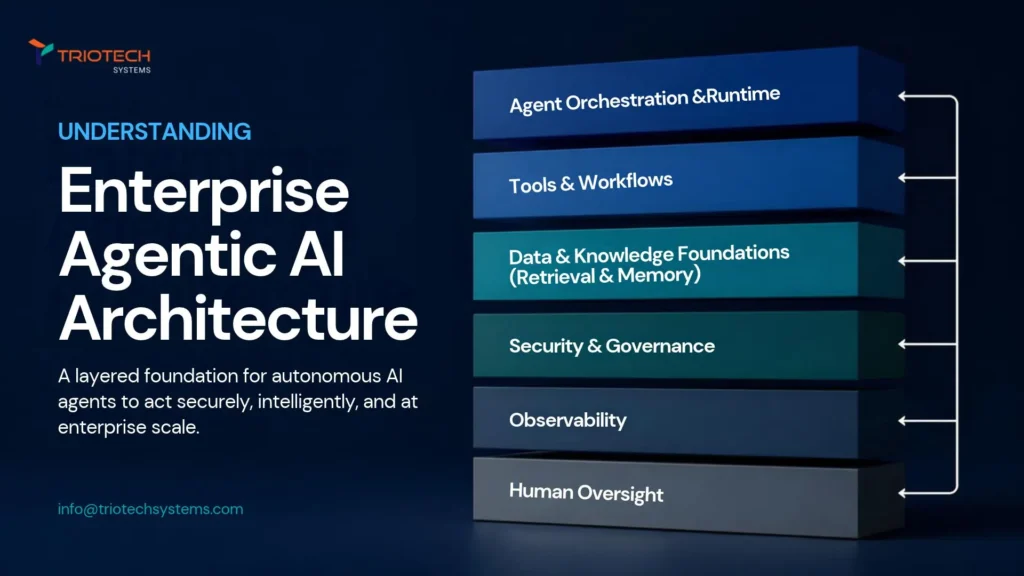
Gartner projects that 40% of enterprise applications will feature task-specific AI agents by the end of 2026, up from under 5% just two years earlier, and yet more than 70% of enterprise AI initiatives still fail to deliver their promised value, with the enterprise ai agent architecture underneath the agent, not the model powering it, cited as the actual cause. An enterprise agentic AI reference architecture exists specifically to close that gap: a structural framework separating concerns, reasoning via the ai agent orchestration layer, ai agent memory architecture, tool access, governance, so a system can scale, stay auditable, and survive contact with real production traffic rather than collapsing the moment it leaves a demo environment. This guide covers what that architecture actually looks like in 2026, synthesized from how multiple independent enterprise deployments and analyst frameworks currently converge on the same core structure, even when they count the layers differently.
Why “An LLM With a Tool List” Isn’t an Architecture
The agent diagrams that circulated in 2023 and 2024 showed a single box: a model, a handful of tools, a memory blob. That abstraction has fully collapsed under real production contact. Production agentic systems handle 300-500x more queries than a prototype, need to survive a 3am pager alert as gracefully as a compliance audit, and have to keep working when a model provider changes pricing or deprecates an endpoint, none of which a single undifferentiated box can do. The real agentic ai architecture layers that have emerged separate these concerns deliberately, so each one can be built, scaled, or replaced independently.
The Core Layers of Enterprise Agentic AI Architecture
Different organizations and analysts count these layers differently, some compress to four, others separate out as many as seven, but the actual components converge consistently across every serious 2026 reference architecture:
Foundation Model Layer: The LLM itself, increasingly treated as an interchangeable component rather than a permanent commitment, covered in depth in our Bedrock vs Foundry vs Gemini Enterprise vs OCI comparison. Model-agnostic design at this layer is what lets an organization swap providers without rearchitecting everything above it.
Agent Runtime / Orchestration Layer: Manages agent lifecycle management, planning, and reasoning, the layer AWS Bedrock AgentCore, Microsoft Foundry Agent Service, and Google’s Agent Runtime all occupy, covered directly in our AgentCore vs Foundry Agent Service vs Google Agent Runtime comparison. This is where multi-agent architecture coordination actually happens, a primary agent delegating to specialized sub-agents, tracked and managed as a coherent system rather than independent scripts calling each other informally.
Memory and Knowledge Layer: Dedicated agent memory architecture is becoming standard infrastructure in 2026, the way vector databases became standard in 2024, and conflating memory with agentic RAG/retrieval is one of the most common architectural mistakes current analysts report seeing in real RFPs. These are related but distinct concerns, covered from the retrieval side in our Bedrock Knowledge Bases vs Azure AI Search and Foundry IQ vs Google RAG Engine comparison, memory is what an agent remembers about an ongoing interaction; RAG is how it retrieves grounding context from your actual enterprise data.
Tools and Integration Layer: The design principle here is explicit and consistent across every serious 2026 architecture: agents should never access enterprise systems directly. Instead, they route through standardized protocols, the mcp model context protocol (MCP), the connective tissue most current sources describe as having “won 2025 and consolidated in 2026,” and A2A (Agent-to-Agent) for cross-platform agent communication. This tool integration layer is sometimes paired with a dedicated ai gateway for routing and rate-limiting requests across multiple model providers. Structurally, this is the same problem our Middleware vs API Gateways comparison covers from the traditional application side, a gateway layer mediating access so backend systems aren’t exposed directly, just with an agent instead of a human client on the requesting end.
Observability and Evaluation Layer: By 2026, observability and evals are built into the architecture from the start rather than bolted on after deployment, tracing, drift detection, and quality scoring treated as first-class infrastructure, not an afterthought once something goes wrong in production.
Guardrails and Governance Layer: This guardrails layer moved from “nice to have” to “non-negotiable” specifically between October 2025 and April 2026, as the EU AI Act’s general-purpose AI obligations took effect and its high-risk system obligations approach their August 2026 trigger date. Content safety, prompt injection defense, and output filtering are covered directly in our Bedrock Guardrails vs Azure AI Content Safety vs Google Model Armor comparison.
Compute and Hardware Layer. Underneath all of the above, the actual silicon running inference and training workloads, covered in our AWS Trainium and Inferentia vs Azure AI Accelerators vs Google TPU comparison. Most architecture conversations skip this layer entirely, but at genuine enterprise inference volume, the compute layer’s cost and latency characteristics shape what’s actually feasible at every layer above it.
How the Layers Compose in Practice
A request flows roughly as follows: a user or system event reaches the orchestration layer, which plans the task and invokes the agent runtime. The agent consults memory for relevant context and calls the knowledge/RAG layer for grounding data specific to the task. Any action touching an actual enterprise system routes through the tools/integration layer, never directly, using MCP or a comparable protocol. Guardrails evaluate both the request and the generated response before anything reaches a user or takes an action with real consequences. Observability captures the full trace for later evaluation, drift detection, and audit. All of this runs on the foundation model and compute layers, which should remain swappable without requiring the layers above to be rebuilt.
The Governance Imperative, Concretely
This isn’t abstract compliance theater. The EU AI Act’s high-risk system obligations reach their August 2026 trigger date, and agentic systems making or influencing real decisions, credit, hiring, healthcare, financial services, increasingly fall within that classification. The NIST AI Risk Management Framework provides a voluntary but increasingly referenced structure (Govern, Map, Measure, Manage) that maps cleanly onto the governance layer described above, and is worth building toward regardless of exactly which regulatory regime ultimately applies to a given deployment. For fintech and healthcare organizations specifically, this governance layer isn’t optional architecture, it’s the difference between a deployable system and one that can’t pass its own compliance review.
Common Architectural Mistakes
Treating memory and RAG as the same thing: They solve related but genuinely different problems, conflating them is explicitly named as one of the most frequent mistakes current analysts see in real enterprise RFPs.
Letting agents access enterprise systems directly: Every serious current reference architecture treats this as a hard boundary, not a convenience trade-off, direct access removes the audit trail and access control a tools/integration layer provides by design, built on the same MCP standard most current agent platforms have converged on.
Bolting on governance after deployment: Given the regulatory timeline above, retrofitting guardrails, human-in-the-loop review points, and audit trails onto a system already in production is measurably harder than designing them in from the start.
Treating the model as a permanent architectural decision: Foundation models are increasingly interchangeable components in a well-designed 2026 architecture, hard-coding deep dependencies on one specific model’s quirks throughout your orchestration and tooling layers defeats that flexibility before you need it.
Build vs. Buy by Layer
Not every layer deserves the same build-vs-buy decision. Foundation model, observability tooling, and guardrails are generally infrastructure problems that specialized vendors solve better than an internal team will, given how fast those categories move. Orchestration logic, tool definitions, and memory architecture encode your actual product logic and business rules, these are the layers worth owning rather than outsourcing, since they’re what makes your specific agentic system valuable rather than a generic wrapper around someone else’s platform.
The Bottom Line
An enterprise agentic AI reference architecture isn’t a single product you buy, it’s a disciplined separation of concerns across foundation model, orchestration, memory, tools, observability, and governance layers, each able to scale or change independently. The organizations getting real value from agentic AI in 2026 are the ones that treated this as a deliberate architectural decision from the start, not the ones that scaled a demo-stage “LLM with a tool list” directly into production and discovered the gaps under real load, real audits, and real regulatory scrutiny.
Building This Architecture Properly
Designing and implementing this across real production systems, not just the model layer, but the orchestration, memory, tooling, and governance layers that actually determine whether it survives contact with production, is exactly the kind of work AI software development covers. Ongoing monitoring of the orchestration and observability layers once live, real data engineering behind the memory and knowledge layer, and systematic evaluation of agent behavior before and after deployment are all real, ongoing engineering disciplines this architecture depends on, not one-time setup tasks. If you’re architecting an agentic AI system and want it built on a reference architecture that actually holds up, reach out.
Frequently Asked Questions
What is enterprise agentic AI reference architecture?
A layered structural framework separating an AI agent system’s concerns, foundation model, orchestration, memory, tools, observability, and governance, so each layer can scale, be replaced, or be audited independently rather than functioning as one undifferentiated system.
Why do enterprise AI agent projects fail?
Over 70% of enterprise AI initiatives fail to deliver promised value, with poor underlying architecture cited as the actual cause more often than weak models, a system without clear separation between memory, tools, and governance struggles to scale or stay compliant.
What are the layers of an enterprise AI agent system?
Foundation model, agent runtime/orchestration, memory and knowledge, tools and integration, observability and evaluation, and guardrails/governance, with compute and hardware underlying all of them. Different frameworks count these as four to seven layers depending on how finely they subdivide.
What is MCP and why does it matter for agentic AI architecture?
Model Context Protocol is a standardized way for AI agents to connect to external tools and data sources, replacing the need for a custom integration for every model-and-system combination, widely described as the connective tissue that consolidated the agent tooling ecosystem in 2025 and 2026.
How to design a multi-agent architecture?
Through the orchestration layer specifically, a primary agent delegates specialized tasks to sub-agents, coordinated through the same runtime rather than independent scripts calling each other informally, with A2A protocol support where agents need to communicate across different platforms or vendors.
What are the agentic AI governance requirements 2026 brings into scope?
Specific requirements vary by jurisdiction and industry, but the EU AI Act’s high-risk system obligations (trigger date August 2026) and frameworks like NIST’s AI Risk Management Framework both point toward the same core requirements: auditability, human oversight for consequential decisions, and documented risk management built into the architecture from the start.
Build vs buy enterprise AI agent infrastructure: how should I decide?
Foundation model, observability tooling, and guardrails are generally infrastructure problems specialized vendors solve better than an internal team will. Orchestration logic, tool definitions, and memory architecture encode your actual business logic, these are the layers worth owning rather than outsourcing.
Keep reading
RAG Architecture for Private Company Data
Somewhere in your company right now, an employee asks an AI assistant a question it can't answer, not because the model is weak, but because it…
Read article
AWS Trainium and Inferentia vs Azure AI Accelerators vs Google TPU
Before comparing specs, there's one fact that changes how you should actually read this AWS Trainium vs Azure vs Google TPU comparison: none of these chips…
Read article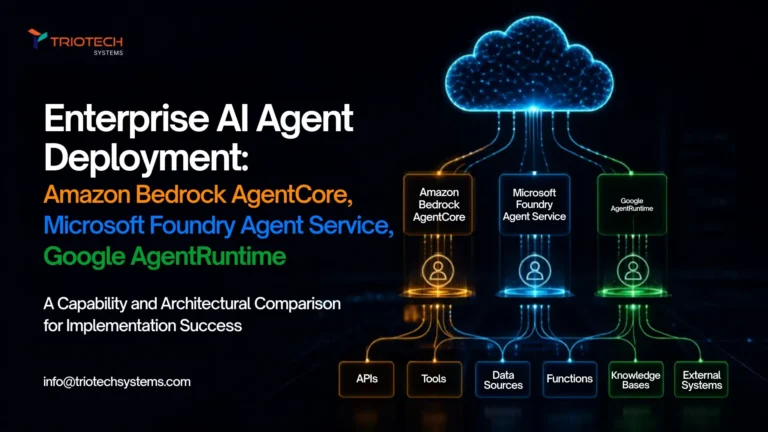
Amazon Bedrock AgentCore vs Microsoft Foundry Agent Service vs Google Agent Engine
Building an AI agent prototype takes an afternoon. Running one reliably for thousands of concurrent enterprise users, with real identity, memory that persists correctly, tool access…
Read articleBuilding on AI or the cloud?
Get a security architect's review of your cloud, CI/CD and AI agent permissions. Free.