Agent Memory Architecture: How to Build Smarter, Context-Aware AI Agents
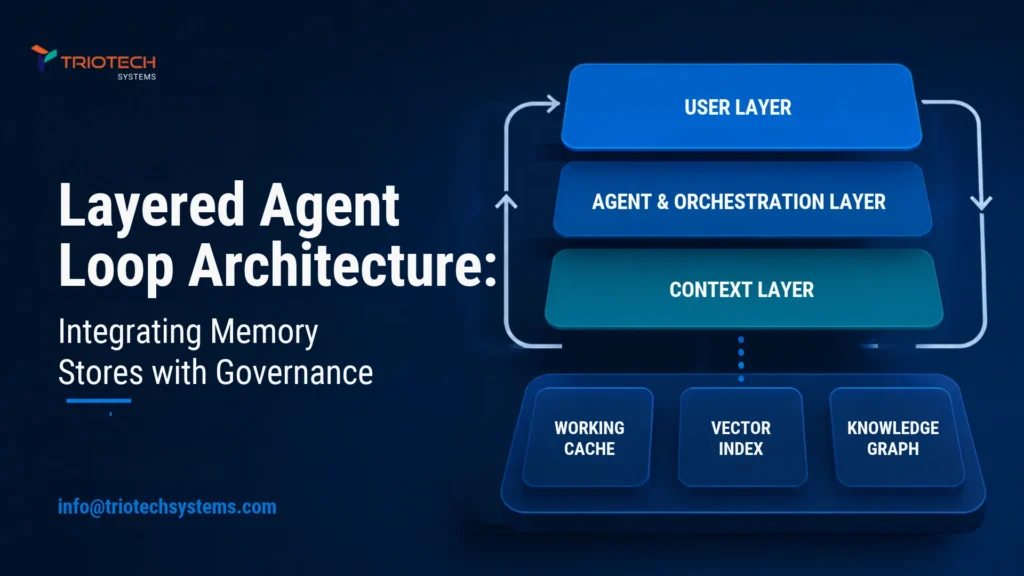
An enterprise AI agent that forgets everything between conversations is a demo, not a colleague. Customers repeat their issue to a support agent. An internal assistant re-asks which project you mean. A software engineering agent repeats a fix that failed yesterday. Each failure traces back to the same gap: the agent has a context window, but no real memory.
Agent memory architecture is the design that fixes this gap. It defines what an AI agent captures, how it stores that information, when it retrieves it, and when it corrects or deletes it. A context window holds what the model can see right now. A persistent memory system holds what the agent should still know tomorrow. Enterprises need that system to be reliable, secure, and scalable, because memory carries customer data, business decisions, and an attack surface.
This guide shows CTOs, architects, and AI engineers in Canada and the United States how to design agent memory architecture for production: memory types, storage choices, retrieval, multi-agent sharing, and governance.
Key Takeaways
- Agent memory architecture separates short-term working memory from long-term memory, and it splits long-term memory into episodic, semantic, and procedural stores.
- A context window is not memory. Persistent memory needs capture, storage, retrieval, consolidation, and deletion.
- Most enterprises need hybrid storage: vector databases for similarity, knowledge graphs for relationships, and relational or document stores for records.
- RAG and agent memory complement each other. RAG brings in external knowledge; memory carries the agent’s own experience.
- Treat every retrieved memory as untrusted data, and enforce access control and provenance on every read and write.
What Is Agent Memory Architecture?
Agent memory architecture is the set of components and policies that let an AI agent store, retrieve, update, and delete information across steps, sessions, and workflows, so it can act with context instead of starting fresh each time. It sits around the large language model and connects to reasoning, tools, and agent orchestration.
A context window is temporary and bounded. When the window fills, older tokens drop out or get compressed, and when the session ends, the content disappears. AI agent memory persists outside the model. The model reads from it and writes to it through controlled operations.
Agent memory architecture supports context-aware decision-making in four ways. It keeps task state so multi-step work finishes. It recalls past interactions so users do not repeat themselves. It stores facts and preferences so answers fit the person. It remembers procedures so the agent repeats what worked.
Consider a customer support agent. Working memory holds the current ticket. Episodic memory recalls that this customer reported the same billing error twice last month. Semantic memory holds the refund policy. Procedural memory holds the approved steps for a refund. Together they let the agent resolve the issue instead of restarting the conversation. The same stored preferences also drive personalization, as in recommendation architecture on AWS, Azure, and Google.
How Does Memory Architecture Work in AI Agents?
This is how AI agents store and retrieve information. Production AI memory architecture, including the memory systems for autonomous agents that enterprises deploy, runs a lifecycle with eight stages, and good agent memory management covers every one:
- Information and interaction capture: The agent records messages, tool results, decisions, and outcomes.
- Memory processing and classification: A processing step decides what is worth keeping, tags its type, and removes sensitive fields.
- Embedding and indexing: Embedding models convert text into vectors, and memory indexing adds keys, timestamps, and metadata.
- Memory storage: The system writes to the right store for each memory type.
- Context retrieval: For each new task, the agent queries memory using similarity, keywords, filters, and relationships.
- Memory injection: The context management layer inserts only the most relevant, permitted memories into the prompt.
- Updates and consolidation: The system merges duplicates, summarizes episodes into facts, and supersedes outdated entries.
- Expiration, correction, or deletion: Retention rules, user requests, and audits trigger removal.
These stages make agent memory architecture a loop, not a database. Weak classification fills storage with noise. Weak retrieval injects the wrong memory. Weak lifecycle management lets stale facts linger. Design all eight stages, not just storage and retrieval.
Types of Memory in AI Agents
Researchers commonly describe language agents with a short-term working memory and several long-term memories: episodic, semantic, and procedural. The Princeton CoALA framework popularized this taxonomy, and most enterprise agent memory architecture designs follow it.
Short-Term or Working Memory
Short-term memory in AI agents holds the active task: the current conversation, recent tool outputs, goals, and temporary state. It lives in the context window and a session cache. Its limit is size. Here is how to manage context windows in AI agents: set a token budget, apply memory summarization and context compression, and let the context management for AI agents layer admit only high-value items. Stateless AI agents keep nothing between calls, while stateful AI agents carry working state forward, so decide early which your workflow needs. Context window management is a design task, not a prompt trick. Session state works the way distributed session management does in web applications: store it centrally, key it to a user, and expire it on purpose, and our post on session management issues in distributed applications covers the same pitfalls. Short-term vs long-term memory in AI agents comes down to persistence: working memory ends with the session, and long-term memory does not.
Long-Term Memory
Long-term memory in AI agents persists across sessions. It stores user preferences, historical interactions, and retained knowledge. Teams implement long-term context retention with databases, vector embeddings, and knowledge graphs. This memory persistence is what makes conversational memory architecture possible: the agent greets a returning user with their history instead of a blank slate.
Episodic Memory
Episodic memory records specific events: a past conversation, a task attempt, a failure, a correction. It answers “what happened last time?” How does episodic memory improve AI agents? It lets them recall outcomes, reuse what worked, and avoid repeating mistakes. Many teams keep it as an append-only, timestamped log.
Semantic Memory
Semantic memory stores facts, concepts, entities, and relationships: policies, product details, customer attributes. Agents often distill it from episodes, such as turning repeated preferences into a stored fact.
Procedural Memory
Procedural memory stores how to do things: workflows, instructions, and reusable task patterns. It lets an agent repeat an approved process, such as a refund workflow, instead of improvising.
| Memory type | Purpose | Stored information | Persistence | Enterprise use case |
| Working (short-term) | Handle the current task | Active messages, tool outputs, goals | Session only | In-progress support ticket |
| Episodic | Recall past events | Timestamped interactions and outcomes | Long-term | Prior incidents with a customer |
| Semantic | Hold facts and knowledge | Entities, policies, preferences | Long-term | Refund policy, account attributes |
| Procedural | Repeat known methods | Workflows, runbooks, task patterns | Long-term | Approved remediation steps |
Core Components of an Enterprise Agent Memory Architecture
An enterprise agent memory architecture combines twelve components:
- Agent orchestration layer: coordinates reasoning, tools, and memory calls.
- Memory ingestion pipeline: captures events and routes them for processing.
- Classification and extraction: labels memory types and pulls out facts.
- Embedding models: produce vectors for similarity search; record the model version so upgrades can regenerate vectors. Hosting and tuning choices are covered in SageMaker vs Azure ML vs Vertex AI.
- Vector databases: retrieve semantically similar memories.
- Relational and document databases: store structured records and flexible documents.
- Knowledge graphs: hold entities and relationships.
- Retrieval and ranking: combine similarity, keyword, and metadata filtering, then rank results.
- Context management layer: decides what enters the context window and trims the rest.
- Update and consolidation engine: merges, summarizes, and supersedes memories.
- Access control and governance layer: enforces who may read and write.
- Monitoring and observability: tracks retrieval quality, latency, and write activity.
Start small with your agent memory architecture. Add a component only when you can name the retrieval failure it fixes. Memory retrieval quality, not storage volume, decides whether the agent improves. A single store with metadata filtering often serves a pilot well.
Agent Memory Architecture: Vector Database vs Knowledge Graph vs Traditional Database
No single store fits every agent memory architecture. Each technology answers a different question.
|
Store |
Best for | Strengths | Limitations |
Suitable scenario |
| Vector database | Semantic similarity over unstructured text | Fuzzy matching, fast recall of related memories | Weak on exact facts, time, and relationships | Past conversations, support notes |
| Knowledge graph | Entities and multi-hop relationships | Explicit relationships, traceable reasoning | Costly to model and maintain | Dependencies, entitlements, org structure |
| Relational database | Structured records and transactions | Consistency, mature access control | Rigid schema, no semantic search | Customer profiles, audit logs |
| Document database | Flexible, evolving documents | Schema flexibility, JSON-friendly | Weaker joins and consistency | Episode logs, session state |
Vector database vs knowledge graph for AI agent memory is rarely either-or. Similarity search finds “things like this,” but it cannot reliably say what is true now or how two entities connect. A hybrid architecture pairs a vector index for recall with a graph or relational store for facts and a document store for episodes. The best memory architecture for enterprise AI agents is usually hybrid, shaped by the workload rather than by a vendor. Hybrid designs add obligations: keep provenance, synchronization, deletion, and access control consistent across every store, including derived embeddings.
RAG vs Agent Memory Architecture
Retrieval-augmented generation (RAG) retrieves external knowledge, such as documents and policies, and supplies it to the model. Agent memory stores the agent’s own experience: conversation history, user-specific context, task outcomes, and learned procedures. RAG is mostly read-only and shared. Memory is read-write and often personal.
They work together in agent memory architecture. An agent uses RAG to look up the current return policy, and it uses memory to recall that this customer already received an exception. Memory entries can be indexed and retrieved with the same machinery as RAG, and retrieval results can feed memory. Enterprise search services such as Amazon Kendra and Azure AI Search (including Foundry IQ) often sit behind the retrieval step, and teams comparing Kendra vs Elasticsearch or weighing a Foundry IQ vs Azure AI Search setup should treat them as knowledge retrieval, not as agent memory. For the retrieval side, see our guide to RAG architecture for private company data and our comparison of Kendra, Azure AI Search, and Google enterprise search.
How to Design a Scalable Agent Memory Architecture
Here is how to design memory architecture for AI agents and how to build scalable AI agent memory systems. For LLM agent memory, persistent memory for AI agents needs a write path, a store, and a read path, and this is how to implement persistent memory for LLM agents: classify each event, write it with metadata, and retrieve it with filters. The same discipline supports AI agent context engineering, which decides what the model sees on each turn. Follow this framework:
- Define memory requirements and use cases. Name the decisions memory must improve.
- Identify what to retain. Keep only useful, necessary information; exclude secrets and raw sensitive data.
- Classify short-term and long-term memory. Decide what expires with the session and what persists.
- Select storage technologies. Match each memory type to a store, as in the table above.
- Design retrieval and ranking. Combine vector search, keyword search, and metadata filtering; rerank by relevance and recency.
- Implement context-window management. Set a token budget, summarize history, and admit memories by value.
- Set update and consolidation policies. Merge duplicates, supersede stale facts, and keep prior versions for audit.
- Implement security and access controls. Enforce permissions on every read and write.
- Add monitoring and evaluation. Track retrieval precision, latency, and error rates.
- Test scalability, reliability, and retrieval quality. Load-test the memory service and replay real conversations.
Four enterprise examples show how agent memory architecture changes:
- Customer support agent: episodic memory of past tickets, semantic memory of policies, strict per-customer isolation.
- Internal knowledge assistant: mostly RAG with light personal memory; permissions inherited from source systems. Teams that see GPTs answer from the wrong internal data usually have a retrieval and access-filter problem, not a model problem.
- Software engineering agent: procedural memory of build and deploy steps, episodic memory of failed fixes, project-scoped namespaces.
- Multi-agent workflow: a shared memory service with per-agent write scopes and provenance.
Agent Memory Architecture for Multi-Agent Systems
How to manage memory across multiple AI agents depends on one question: what should agents share? Use these patterns:
- Agent-specific memory: each agent keeps private working and episodic memory.
- Shared memory: a common store holds facts all agents may use.
- Centralized memory service: one service enforces access, ordering, and audit for every agent.
- Distributed memory: agents hold local copies and synchronize; faster, harder to keep consistent.
Memory synchronization and consistency matter. Two agents can read different versions of a fact, or write conflicting updates. Serialize writes to the same entity, record which agent wrote what and when, and resolve conflicts by trust, timestamp, and review. Business-critical data needs strong consistency; preferences can tolerate eventual consistency.
Prevent one agent from reading another’s unauthorized information with access boundaries. Give each agent its own identity, scope reads and writes by tenant, user, and task, and have agents call a memory service instead of touching stores directly. An API gateway or middleware layer is a natural place to enforce authentication, rate limits, and logging; see middleware vs API gateways. For enterprise AI agent architecture as a whole, see our guides on agent identity and workload authentication and enterprise agentic AI reference architecture explain the identity and orchestration layers.
Security, Privacy, and Governance in Agent Memory
Enterprise AI agent memory security and governance start from one fact: memory is a feature and an attack surface. Data privacy and access control must apply to every read and write, and human-in-the-loop memory management gives reviewers a say over sensitive changes. Memory lifecycle management ties these controls together. OWASP lists memory and context poisoning as its own risk in the Top 10 for Agentic Applications, because agents carry untrusted input forward and keep trusting it over time. See the OWASP discussion of memory as an attack surface.
Broken access control is the most common memory failure in practice. If retrieval ignores user permissions, an agent can surface another user’s data, and the fix follows standard broken access control remediation: check authorization on the server side for every read. Never write hardcoded credentials, API keys, or tokens into memory, and scan memory writes the way you scan CI/CD pipelines for secret leaks. Cover these controls in your agent memory architecture:
- Sensitive data protection: redact personal and secret data before it enters long-term memory.
- Encryption: encrypt at rest and in transit.
- Access control: apply role-based and attribute-based access control, and inherit permissions from source systems.
- Tenant isolation: separate namespaces, keys, and indexes per tenant.
- Retention and deletion: define retention per memory type, and delete across every store, including embeddings and backups.
- Consent and user control: let users view, correct, and erase their memories where policy requires.
- Audit trails: log every write, read, and deletion with identity and timestamp.
How to prevent memory poisoning in AI agents: write only validated content, tag every entry with its source, quarantine suspicious entries, and review changes to high-impact memories. Treat retrieved memory as untrusted data. A poisoned entry, or a stored instruction hidden in a document, can steer the agent when retrieval pulls it into the prompt. Validate memory before it influences actions, require provenance, and apply the same tool-level controls described in our guide on secure tool calling. Managed filters help; compare Bedrock Guardrails, Azure AI Content Safety, and Model Armor.
Canadian and US organizations should map memory retention and deletion to the rules that apply to their industry, data, and jurisdiction, including privacy law and sector rules for healthcare and finance. This is not legal advice. Our work on HIPAA-compliant cloud infrastructure and fintech DevOps compliance shows how these controls fit regulated environments.
Common Agent Memory Architecture Challenges
Every agent memory architecture faces these challenges, and each has a practical fix.
|
Challenge |
Mitigation |
| Context-window limits | Budget tokens; summarize and compress history |
| Wrong or irrelevant retrieval | Hybrid retrieval, metadata filters, reranking, evaluation sets |
| Duplicate memories | Deduplicate at write time; consolidate periodically |
| Stale information | Timestamps, confidence scores, supersession, expiry; the same discipline as cache invalidation |
| Contradictory memories | Trust and recency rules; review queue for conflicts |
| Retrieval latency | Caching, tiered storage, smaller indexes, limit top-k |
| Storage cost | Retention limits, compression, cold storage for old episodes |
| Memory poisoning | Provenance, write validation, quarantine, anomaly alerts |
| Privacy risk | Redaction, minimal retention, access filters |
| Poor lifecycle management | Per-tier retention and deletion policies |
| Scaling across agents | Central memory service, namespaces, load testing |
Stale memory is a cache invalidation problem. A cached answer that outlives the fact behind it causes the same caching issue in an agent: the model repeats an outdated answer with confidence. Invalidate memory when the source changes, and prefer event-driven invalidation over timers alone. Database upkeep matters too. Memory stores need the same care as any production database; see our guide to database maintenance. For cost control, our FinOps cloud cost optimization work covers storage and retrieval spend, and the AI accelerator comparison covers inference cost.
Best Practices for Enterprise AI Agent Memory
These practices keep agent memory architecture reliable in production:
- Store only useful and necessary information.
- Separate temporary context from persistent memory.
- Use metadata and access filters on every query.
- Apply relevance-based retrieval, not “retrieve everything.”
- Track provenance and timestamps for each memory.
- Set expiration and deletion policies.
- Evaluate memory quality regularly with real queries.
- Isolate tenant and user data.
- Protect memory from malicious updates.
- Monitor retrieval accuracy and latency.
- Keep human oversight for sensitive decisions, including human review of memory changes.
For monitoring and operations, see our AIOps and DevOps services and 24/7 IT infrastructure monitoring. For the data layer, see MLOps and data engineering services.
Conclusion
A well-designed agent memory architecture improves context retention, continuity, reasoning, and reliability. It separates working memory from long-term memory, matches storage to the question each memory answers, and treats security and lifecycle management as core design, not afterthoughts. The right agent memory architecture depends on your use cases, security requirements, data types, retrieval needs, and scale.
If your team is planning enterprise agents, Triotech Systems can help with AI software development, custom AI agents and RAG frameworks, and the surrounding cloud and security work. Explore our AI engineering guides or contact our team. Browse all Triotech services or start from the Triotech Systems.
Agent Memory Architecture Glossary
- Context window: the tokens a model can read in one request.
- Working memory: active, short-lived task state.
- Episodic memory: a record of specific past events and outcomes.
- Semantic memory: stored facts, entities, and relationships.
- Procedural memory: stored workflows and reusable methods.
- Memory consolidation: merging and summarizing memories into durable knowledge.
- Provenance: the record of where a memory came from and who wrote it.
- Memory poisoning: malicious or false data written into memory to steer later behavior.
- Supersession: marking an old fact as replaced while keeping it for audit.
- Tenant isolation: keeping each customer’s memory separate.
- Agent memory architecture: the design for how an agent stores, retrieves, updates, and governs memory.
FAQ
What is agent memory architecture?
Agent memory architecture is the design that lets an AI agent capture, store, retrieve, update, and delete information across sessions. It combines working memory, long-term stores, retrieval, and governance so the agent acts with context instead of relying on a single context window.
How does memory work in AI agents?
The agent records interactions, classifies and embeds them, stores them, and retrieves relevant items for each new task. A context layer injects the best matches into the prompt. Consolidation merges duplicates and updates facts, and retention rules remove expired data.
What are the different types of AI agent memory?
The common types are working (short-term) memory for the active task, and long-term memory split into episodic memory for past events, semantic memory for facts, and procedural memory for workflows and reusable methods.
What is the difference between short-term and long-term agent memory?
Short-term memory holds the current task and conversation inside the context window and lasts for the session. Long-term memory persists across sessions in external stores, holding preferences, history, and knowledge that the agent retrieves when needed.
Do AI agents need vector databases?
Not always. In agent memory architecture, a vector database helps retrieve similar unstructured memories, but small or structured workloads can use a relational or document store with keyword and metadata filters. Add a vector index when similarity retrieval fixes a measured failure.
What is the difference between RAG and agent memory?
RAG retrieves external knowledge, such as documents, to ground answers. Agent memory stores the agent’s own experience, such as conversations, preferences, and task outcomes, and updates over time. The two work best together.
How do AI agents retain information across conversations?
They write important information to persistent stores keyed to a user, tenant, or task, then retrieve it at the start of later conversations. Classification, embeddings, and metadata filters decide what returns, and permissions decide who may see it.
How do you secure memory in enterprise AI agents?
Redact sensitive data, encrypt stores, enforce access control and tenant isolation, log every read and write, and set retention and deletion rules. Treat retrieved memory as untrusted input, track provenance, and validate memory before it drives actions.
Can multiple AI agents share the same memory?
Yes, through a shared or centralized memory service. Give each agent its own identity and scoped permissions, serialize conflicting writes, record provenance, and separate private memory from shared memory so agents never read unauthorized data.
What is the best database for AI agent memory?
No single database wins in agent memory architecture. Use vector databases for similarity, knowledge graphs for relationships, relational databases for structured records, and document databases for episodes. Most enterprises combine them, guided by access, latency, and consistency needs.
How do AI agents handle stale or conflicting memory?
They attach timestamps and confidence to each memory, supersede old facts instead of deleting them silently, and apply trust and recency rules when two memories conflict. Event-driven invalidation, like cache invalidation, removes memories when the source system changes.
Why does an agent return wrong internal data?
Usually retrieval returns the wrong or unauthorized memory, or an index is stale. Add metadata filters, per-user access checks, and evaluation sets built from real questions before blaming the model.
Keep reading
Secure Tool Calling: How to Protect Enterprise AI Agents
An AI agent that only answers questions is a convenience. An AI agent that calls your CRM, queries a database, retrieves a document, creates a ticket,…
Read articleAgent Identity and Workload Authentication
AI agents and automated workloads now call internal APIs, query databases, open tickets, and trigger business workflows without a person at the keyboard. Each of those…
Read article
RAG Architecture for Private Company Data
Somewhere in your company right now, an employee asks an AI assistant a question it can't answer, not because the model is weak, but because it…
Read articleBuilding on AI or the cloud?
Get a security architect's review of your cloud, CI/CD and AI agent permissions. Free.